What Would an Alien Anthropologist Visiting Earth Think Is Humanity’s Most Distinctive Activity?
More than the so-called “death of boredom”, we should be worried about the death of mind-wandering
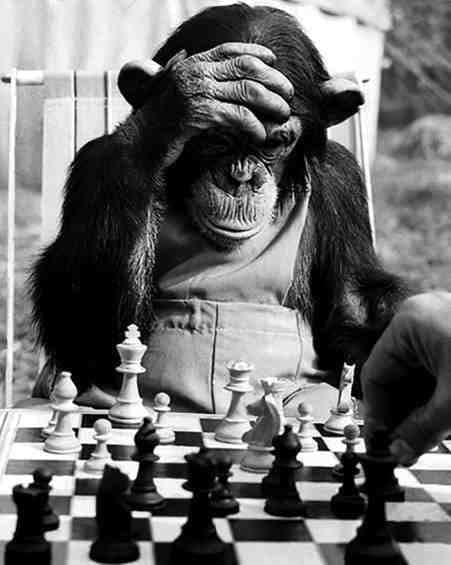
I am sitting with a philosopher in the garden; he says again and again ‘I know that that’s a tree’, pointing to a tree that is near us. Someone else arrives and hears this, and I tell him: ‘This fellow isn’t insane. We are only doing philosophy.’
—L.Wittgenstein, On Certainty
In the still ongoing Candidates Tournament, chess number two, Hikaru Nakamura, complained that he never got the memo from his assistants about which move was the correct one in his match against Javokhir Sindarov.
Not only is the individual chess player outsourcing his own cognitive labor to human assistants, but those same assistants are outsourcing their cognitive labor to chess engines just to prep him.
The cynical take is that a chess player is now just the guy who shows up to click the moves his computer’s computer told him to play.
(This reminds me of the joke on the internet: College is when you spend $100.000 to write papers with AI so your professor can grade them with AI and then you get a piece of paper that says you’re allowed to have a job and then they don’t call you back for interviews because the job you were educated for was taken by AI.)
Well, perhaps that’s too cynical, but it’s hard to shake the thought that all this external help—outsourcing intellectual labor to a kind of hive mind of assistants and AI—is quietly selecting for less creative players, at the expense of those whose primary incentive is the pleasure of relying on their own cognitive resources.
Also, why Bobby Fischer gave up on chess.
Fischer’s mental issues and quirks played a role, of course, but he also famously decried “memorization” in chess—and I tend to think that played a role as well. The whole point of Fischer random was to counteract it.
As he said:
Creativity is lower down on the list. The old Chess is… you are banging your head against the wall with this theory… where you are, you know, trying to find some little improvement on move 18 or 20… it’s ridiculous! It gets harder and harder and harder, and you need more and more computers, and more and more people working for you… and less and less creativity. It’s ridiculous!…But why do you want to get involved with something that is mainly rote learning and pre-arrangements? Obviously it’s not all… you know, that. But creativity is like maybe number 3 on the list. The first is pre-arrangement, and then memorization, and then comes creativity.
Of course, this is not to say that Fischer did not rely on memorization and preparation himself—of course he did. But he came to see the escalating arms race of preparation, later amplified by computers, as a problem that was killing chess’s spirit.
For all the talk about outsourcing cognitive labor to the hive mind of computer engines, it should not be overlooked that chess is one of the most distinctive human activities.
Think about it for a moment
An alien anthropologist visiting Earth and observing a classical game of chess would have to ponder the meaning of this activity. First of all, there is not much activity at all. Two players sit opposite each other, staring at wooden pieces, doing nothing most of the time and moving them only occasionally in successive order.
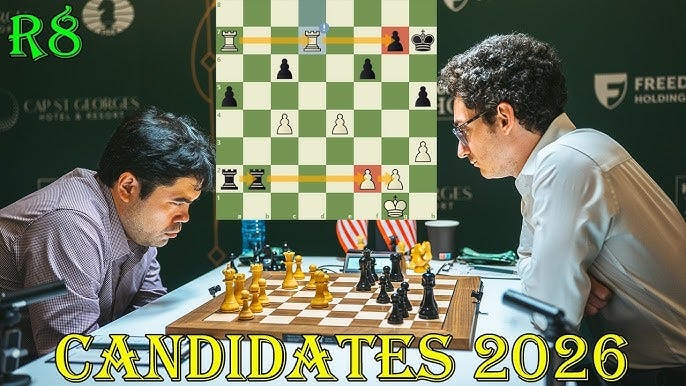
This is because the game of chess does not consist of what is observable. Any configuration of chess pieces, and their movement on the board by the player, constitutes what is seen. What is not seen, however, is all the movement of chess pieces that takes place in each player’s mind—something inaccessible to our alien anthropologist, or indeed to anyone else.
Any actual, observable physical move of a chess piece is preceded by hundreds and hundreds of mental moves.
The beauty of a chess game often consists in what actually did not happen on the physical board but could have happened, and it is precisely this “could have happened” that explains what actually did happen on the board.
Every move presupposes the elimination of alternative possibilities.
Any observable chess game rests upon a vast number of eliminated possibilities, a vast number of unrealized possible worlds.
No other animal comes anywhere near this capacity to eliminate possibilities in its mind.
Indeed, some animals are so slavishly dependent on the visual and sensory stimuli before them, so incapable of a prolonged stream of thoughts independent of immediate stimuli, that they must concoct elaborate ways of keeping their minds busy—forever seeking movement and external stimulation and distraction, all in an effort to avoid ever being alone with themselves.
More than the so-called “death of boredom”, I’m worried about the death of mind-wandering.
There are always some stimuli around us, but not all are designed for us. Living in modern world means being constantly surrounded by stimuli designed to compete for our attention, to hijack our limited attention resources and direct them in particular ways, ways that are not always beneficial for us.